Tuesday, March 30, 2010

Solution Chemistry - Mar.30

In today's class we learned about solute, solvents, solubility, saturated and unsaturated solutions.

- Solution Chemistry is the study of chemical reactions in solutions
- A solution is a homogeneous mixture
- Solvents are components present in larger amounts
- Solutes are components present in smaller amounts
- A solute is soluble (dissolves) in a solvent if it dissolves to form a homogeneous mixture
- A saturated solution contains as much solute as possible
- An unsaturated solution can dissolve more solute
- Solubility is the measure of how much solute can dissolve in a given solvent (g/L, g/mL, mol/L, ppm-parts per million)
- The solubility of Ba(NO3)2 in water is 63g/100mL @25 degrees celcius
- The solubility of Ba(NO)2 in alcohol is 1.6g/100mL @25 degrees celcius
- Effects: heat, change of solute/solvent

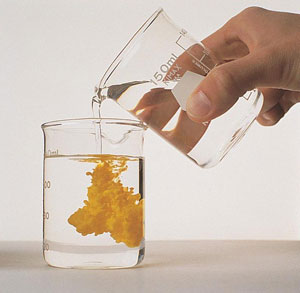
Example of a Saturated Solution: Water bottle with plain water
Example of an Unsaturated Solution


Friday, March 26, 2010

Atoms and Ions march 22,2010

Atoms and Ions

  • Atoms are electrically neutral
  • # of protons = #of electrons
  • Ions have different # of protons and electrons
  • Ions can be either positive (lost e-) or negative (gained e-)
  • Cations = positive ion
  • Anions = negative ion
Examples
  • Determine how many electrons each of the ions have. What type of ion are they (cation/Anion)

Ca2+ -> lost 2e-, 18 electrons, cation

F- -> gained 1 e-, 8 electrons, anion

H+ -> lost 1e-, 0 electrons, cation

H- -> gained 1 e-, 2 electrons, anion

Examples

76 As 3- -> 33 p+, 43 n, 36 electrons (gained 3)

201 Au+ -> 79p+, 122n, 78 electrons (lost 1)

Bohr diagrams for Ions


Bohr diagrams could also be written as:

8e-
2e- 2e-
10 4
9 F 3 Li

Chemical Bonds
  • A bond is an electrostatic attraction btwn particles
  • Bonds occur as elements try to achieve Noble gas electron configuration
  • Noble gases (usually) do not form compunds or bonds
  • In Noble gases the outermost energy level have stable octets.
  • Metals lose electrons (oxidize)
  • Non metals gain electrons (reduced)

Lewis Dot Structure

  • Atoms can be represented by dot diagrams
  • Dots represent electrons
  • Only Vanlence level electrons are shown
  • Wtrite the atomic symbol for the atom
  • -this rep. the nucleus and filled inner electron leves
  • one dot is used to rep outer energy level electrons
  • one e- is placed in each orbital before any pairing occurs
  • - beginning with the 5th e-, pairing can occur up to a maximum of 8e-

Example

Carbon, Hydrogen, Nitrogen


Ionic Bonds (have brackets (covalent dont have brackets)

  • electrons are transferred from metal to nonmental. no dots are shown on metal
  • charged species is written in brackets


Friday, March 5, 2010

EMISSION SPECTRA - MARCH 5 CLAASS

Emission Spectra

  • Each element gives of a specific colour of light
  • These are known as emission spectra -Unique to each element
  • If electrons absorb energy they can be bumped to a higher level
  • When they fall to a lower level, they release that energy as light.

Atomic Structure


  • Atoms are made up parts called subatomic particles
  • Protons(+)
  • Neutrons(neutral)
  • Electrons(-)

Particle (Multiples of Proton) (Elementary Charges) Location

Mass Charge

Proton 1 1+ Nucleus

Neutron 1 0 Nucleus

Electron 1/1837 -1 Outside

Atomic Number -Number of protons

Isotopes

  • The number of protons determine the type of element
  • Changing the number of neutrons changes the isotope of the element.
  • All isotopes have the same chemical properties

1 proton = protium

1 proton and 1 neutron = deuterium

1 proton and 2 neutrons = tritium

Mass Number

  • Mass Number = total of protons and neutrons
  • Symbol given is A
  • Different Isotopes have different masses


Wednesday, March 3, 2010

Bohr Model - March 3 Class

- Atoms are electrically neutral
- Two different models can be used to describe electron configuration: Energy level model and Bohr model
- Electrons occupy or orbitals:
  1. 2e in the first orbital
  2. 8e in the second orbital
  3. 8e in the third orbital
    All of these orbitals combined are called an octet


Orbital Shapes:
- Atomic orbitals each have a specific name and shape.


Hybridized Orbitals:
- The first of the Bohr levels is the 1s-orbital and it holds 2e-
- The second level contains 2s, 2px, 2py, 2pz orbitals. They combine (hybridize) to form 2sp3 orbital

Thursday, January 28, 2010

Stoichiometry Investigation Lab - Jan 28, 2010 Class

LAB:

Stoichiometry Investigation
Testing the Stoichiometric Method

The purpose of this lab is to test if Stoichiometry accurately predicts the mass of the products produced in chemical reactions.

Experimental Design:

2.00g of Strontium nitrate is dissolved in 50mL of water and then reacted with excess Copper (II) sulphate (3.00g). The product is a precipitate( Strontium sulphate and Copper (II) nitrate. After mixing the solutions the precipitate will be separated by filtration, dried and weighed.

Prediction:(What is the theoretical mass of the precipitate?)

1. What is the balanced chemical equation for this reaction?
Sr(NO3)3 + CuSO4 -> SrSO4 + Cu(NO3)2


2. If 2.00g of Strontium nitrate completely reacts, how many grams of Strontium sulphate should be produced?


Procedure:
  1. Carefully measure about 3.00g of Copper (II) sulphate.
  2. Crush the Copper (II) sulphate into a fine powder using a mortar and pestle
  3. Dissolve the Copper (II) sulphate in 50mL of water
  4. Carefully measure 2.00g of Strontium nitrate and dissolve it in 50mL of water
  5. Slowly pour the two solutions together
  6. Stir the mixture to complete the reaction
  7. Write your group name on a piece of filter paper
  8. Find and record the mass of the filter paper
  9. Using a funnel and an Erlenmeyer flask, place the filter paper in the funnel. Slowly pour the mixture into the funnel
  10. Pour the filtrate into the waste collection bottle
  11. Place the filter paper in the drying oven and record the mass when its dry.

Wednesday, January 27, 2010

Mass to Mass Problems - Jan26 Class

Lead (IV) Nitrate reacts with 5.0 g of potassium iodide. How many grams of lead (IV) nitrate are required?


Potassium Iodide:


How many grams of O2 are produced from the decomposition of 3.0g of potassium chlorate?


If 5.0g of potassium chlorate decomposes, what volume of O2 at STP is produced?


If a 100mL solution of 2.0 M H2SO4 is neutralizd by sodium hydroxide, what mass of water is produced?


Percent Yield
- The theoretical yeild of a rxn is the expected (calculated) amount.
- The experimental amount is the actual yield:
% = Actual/theoretical x 100
Example: The production of urea CO(NH2)2 is given by: 2 NH3 + CO2 --> CO(NH2)2 + H2O

If 47.7 g of urea are produced when 1 mole of CO2 reacts, find the actual yield, theoretical yield and percent yield.
Actual yield: 47.7g
Theoretical yield: 1mol CO2 x 1 CO(NH2)2/1 mol CO2 x 60.1g / 1 mol = 60.1g
Percent yield: 47.7g / 60.1g x 100 = 79.4%

Friday, January 22, 2010

Stoichiometry - Jan. 22

In today's class we learned about Stoichiometry and did many examples.

Stoichiometry
- Coefficients in balanced equations represent moles
- They are also conversion factors

*Always write a balanced equation

Examples:
If a 0.3 mole sample of methane reacts with oxygen, how many moles of each product are produced?


Converting to mass requires one additional step

Example
How many grams of water are produced if 0.84 mol produced of phosphoric acid is neutralized by Barium hydroxide?